The most effective stress-regulation tool available to you right now costs nothing. It takes five minutes. And you'll never see it featured on a major podcast — because it's almost too embarrassing to recommend. Todd Vande Hei is recommending it anyway. Two practices — humming and walking meditation — look absurdly simple on the surface but carry surprisingly serious science behind them. Neither requires an app, a subscription, a retreat, or 45 minutes carved out of your morning. Both work in the margins of an already packed day. And both produce measurable effects on the autonomic nervous system — the system that determines whether you're in recovery mode or chronic stress mode at any given moment.
The Vagus Nerve: Why This Matters for Executives Running at Full Speed
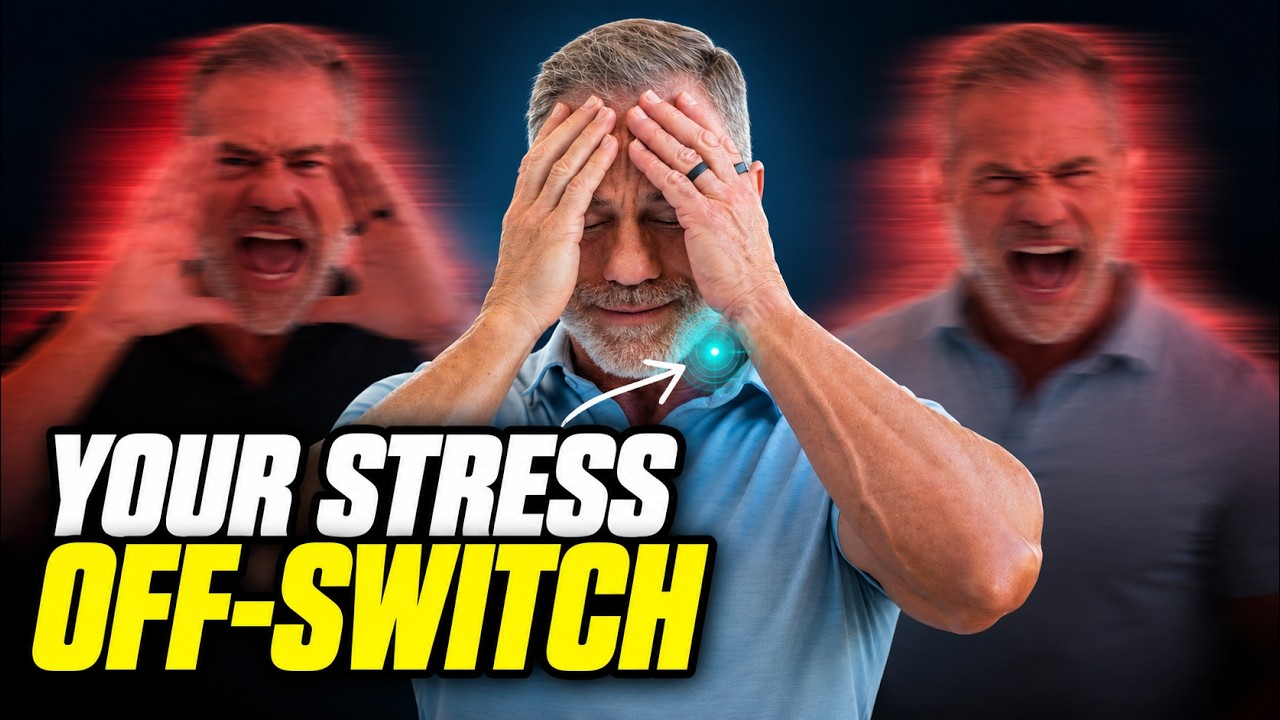
The vagus nerve is the superhighway of your parasympathetic nervous system. It runs from your brain stem down through your heart, lungs, and gut — and when it's active, you're in rest-and-recover mode. HRV is high, cortisol is low, digestion works, sleep improves. But for most executives and CEOs operating at sustained high output, the default state is vagal suppression: low-grade chronic stress response. HRV low. Cortisol elevated. Your body slowly paying what Todd describes as a tax you don't notice until the bill comes due — with penalties — many years later. The two practices below are not replacements for sleep, training, or nutrition. They're margin tools: high-yield interventions for the time and attention you have left after the fundamentals are in place.
Practice 1: Humming — Manual Vagal Activation That Takes Two Minutes
Humming literally activates the vagus nerve through a specific anatomical mechanism. The laryngeal branch of the vagus nerve runs directly through your vocal cords. When you hum, you create vibrations that stimulate that branch directly — it's essentially manual vagal activation without any equipment or technique to learn. The research behind this is real. A 2025 review and multiple controlled studies showed that humming produces small to moderate but consistent improvements in HRV within a single session. The effect is most pronounced when humming slowly at a low pitch for two to five minutes.
The practical application for busy executives: hum in the shower, hum in the car between calls, hum during your commute. You don't need silence. You don't need a mat. Nobody on the road can see you doing it. The cost is zero. The time cost is almost zero. That combination — meaningful physiological benefit with virtually no additional time or effort — is genuinely rare. Todd's verdict: yes, do this. The evidence is real, and there is essentially no barrier to entry.
Practice 2: Walking Meditation — The Busy Person's Mindfulness Protocol
Seated meditation has the strongest evidence base in mindfulness research. It also has a terrible compliance rate among high-performing executives, because it requires you to close your office door and be still and silent for a dedicated block of time — both of which are hard to manufacture consistently. Walking meditation solves the compliance problem. A 2026 analysis of Healthy Minds program users — one of the largest meditation research data sets available — found that active meditation performed during walking, commuting, and routine movement produced comparable outcomes to seated meditation for stress reduction and emotional regulation.
The mechanism differs from seated practice, but the outcomes overlap significantly. Walking activates bilateral brain stimulation — the alternating left-right movement pattern that naturally reduces emotional activation. It's the same principle behind EMDR therapy. Add mindful attention (present-moment awareness of your surroundings, your breathing, how your feet feel on the ground) and you get the compounding effect. You also stop doing something that's silently destroying your performance: staring down at your phone while you walk.
For executives, this means your 15-minute walk between meetings, your walk from the parking lot to the front door, your post-lunch loop — all of that can double as genuine stress regulation if you're moving with intentional attention instead of a phone in your hand. Todd's approach: during Zone 2 cardio on an Airdyne bike, no podcast, no content. Ten minutes of nothing but awareness of how his body feels and his own breathing. His verdict: yes, do this. Leave the phone. Walk slowly enough to actually notice where you are. Start with five-minute blocks.
The Results: What Stark Students Actually See
The Stark students who implement both practices consistently — even just two to three minutes of humming and one mindful walk per day — show measurably better HRV trends within two weeks. The improvement isn't dramatic. But it's real, and it compounds over months and years. If your HRV has been chronically low and you've already addressed sleep, training, and nutrition, this is likely your next lever. And it's not a hard one to pull.
Key Takeaways
- Humming directly stimulates the laryngeal branch of the vagus nerve, producing measurable HRV improvements within a single session. Two to five minutes at a low, slow pitch is the effective range.
- Walking meditation produces outcomes comparable to seated meditation for stress reduction — with far better compliance for time-constrained executives.
- Both are margin tools — they work in the gaps of your day without requiring dedicated time blocks. Shower, commute, walk between meetings.
- Stark students doing both consistently show improved HRV trends within two weeks. Small numbers, real and cumulative.
- These practices don't replace the fundamentals (sleep, training, nutrition). They're the next lever once the fundamentals are in place.
- The practices that are too simple to take seriously are often the ones that move the needle most. Nobody is building a startup around humming — which is probably why it keeps getting overlooked.
Ready to build a body that performs?
Stark measures HRV, body composition, and stress biomarkers — then builds a protocol around your actual data. Newport Beach and Tustin/Irvine.
Schedule a ConsultMedical Disclaimer: This content is for educational and informational purposes only and is not intended as medical advice. Always consult with a qualified healthcare professional before making changes to your health protocols.